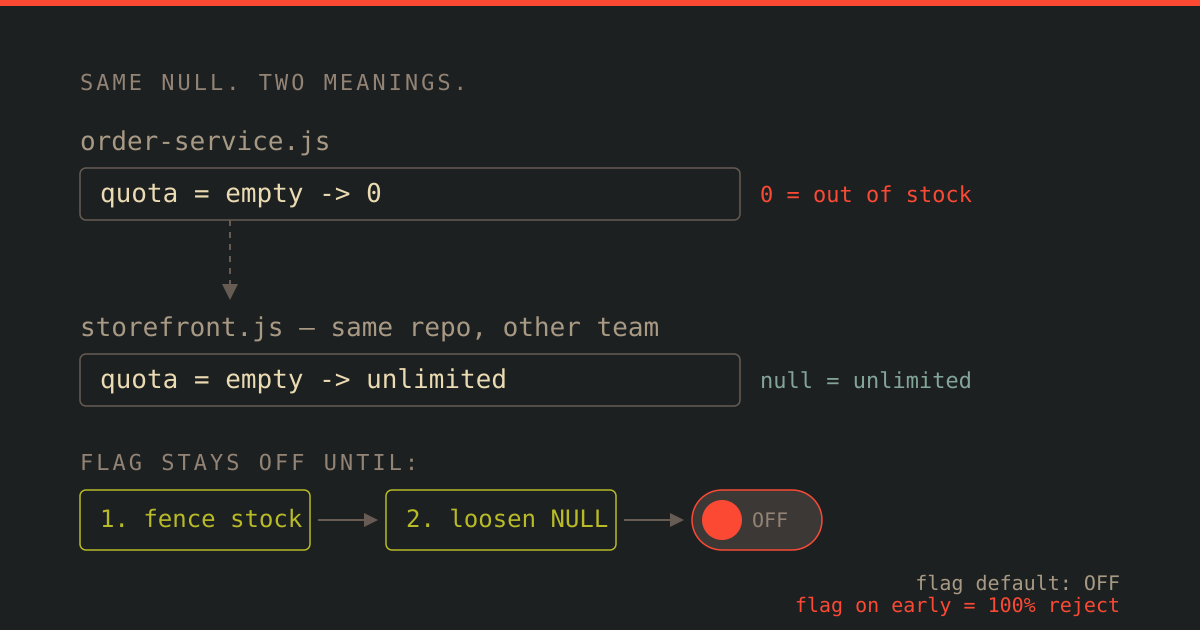
There’s a kind of bug I never saw in a log, because it never ran: I read it straight out of two lines of code, before writing a single line of my own. The question wasn’t “how do I fix this” — it was whether shipping something you already know will fail every single time, if flipped on too early, counts as done.
Context
Early this September I owned the backend piece of a second stock mode for promotional campaigns. The mode already in production: a product has to be allocated a fixed quota before it can sell in a campaign. The new mode is the reverse: a product gets no quota of its own — it sells against the warehouse’s available stock, live, at order time. The feature had a fixed ship date, and my part sat inside it.
My scope was the quota service, where I had full write access. But orders flow through a second service, owned by another team, and that service has to read the new quota value correctly before anything can actually sell. I had no merge rights into that repo.
The conflict
Before writing any code, I read through that other service to see how it reads quota.
Two spots in the same repo treated an empty value (NULL) in opposite ways:
- The order check coerces an empty quota to zero. Empty means “out of stock,” the order is rejected.
- The storefront treated
NULLas “unlimited,” so the product still showed as purchasable.
The new mode isn’t encoded in NULL. It has its own column that states the stock source
explicitly: own quota, or shared pool. NULL in the quota column is just a consequence —
a row selling from the shared pool has no quota of its own to write. But the other
service doesn’t read that source column yet. It only sees NULL, and reads NULL two
opposite ways. Going back through the design doc, the count was worse than two: NULL
is read as 0 in three places and as unlimited in three others, across two systems.
What I could see from two lines: turn the mode on, and every shared-pool order gets rejected while the screen keeps saying the item is in stock.
I couldn’t fix it myself — wrong repo, wrong team. Why two spots in one repo disagree, I don’t know and didn’t go asking; this post only covers what I read. The other team wasn’t negligent either: the failure only exists once the new mode is on, and the mode didn’t exist yet.
Two things were true, and they couldn’t both win. The ship date was fixed, and nothing in my own scope justified slipping it. And turning the flag on before the other team’s fix landed meant 100% of shared-pool orders rejected the first time a customer tried the feature — a public failure, in exactly the place meant to impress.
What I decided
I shipped the code and the migration on schedule, but kept the flag defaulted off in production. Then I wrote the condition for turning it on as a mandatory two-step deploy order for the other team:
- Fence the allocated stock first. Stock already allocated to other campaigns has to be split off from the shared pool, so an “unlimited” order can’t sell into it.
- Loosen the
NULLhandling second. Only once the pool is fenced does the order check change: empty no longer means out of stock.
Reversing the order produces the opposite failure. Flag on too early: every shared-pool order is rejected. Loosen before fencing: 100% oversell. The reason: between the two steps, a shared-pool order is held back neither by its own quota nor by the allocated stock.
An illustrative number, to show why the order matters. Say the warehouse holds 10
physical units, all 10 already allocated to another campaign — so the shared pool is 0.
Loosen NULL before fencing: a shared-pool order reads “unlimited” and sells all 10 of
the other campaign’s units. Fence first, then loosen: the same order sees a pool of 0 and
is correctly rejected.
The flag being off isn’t just a hidden button. It’s checked at two layers: the UI, and the request/import layer. Calling the API directly with the flag off is still rejected. And the go condition isn’t only “the other team has deployed”: production data has to pass the pre-check queries with 0 offending rows first.
The flag here isn’t for gradual rollout. It’s a way to turn a cross-team dependency into something checkable: the flag being off means the conditions aren’t met, and the conditions live in a document anyone can read.
The cost
As of writing, the flag is still off. The feature is in production — but for real users nothing has changed. From the outside that looks like an unfinished feature, even though my part was done on schedule. “Done” for the whole feature now depends on the schedule of a team I don’t control.
I also took on work outside my original scope: writing a deploy-order document for a repo that isn’t mine, clear enough for the other team to follow without me in the room. And the business value of the new mode is delayed by however long the other team takes to deploy. How long, how many orders — I don’t have those numbers yet, because it isn’t over.
What I’d do differently
Next time I’d read the dependent service’s code during design review, before writing any of my own — not after picking up the work and finding it then. “How does the downstream service handle an empty value” should be a mandatory item in any cross-team design review, not something one engineer digs up out of a habit of reading code before changing it.
I’d also push for treating the flag as a two-party contract from day one, instead of setting the condition alone and handing it over. A deploy order agreed at design time sits in both teams’ backlogs from the start, rather than being a document one side writes and the other side waits to read.
Have you ever had to ship something you knew would fail if switched on at the wrong moment? How did you convince the dependent team?