Last month, when I started building an AI Agent system, I began with a simple script of about 200 lines. Everything worked perfectly until I added the fifth tool and started handling asynchronous tasks. The code quickly devolved into an un-debuggable mess of spaghetti code.
That’s when I realized: Building an AI Agent isn’t just about writing prompts or calling LLM APIs. It is a Software Engineering problem. The loop.py file that I subsequently redesigned stands as a testament to applying the four classic OOP principles to control the complexity of the ReAct (Reasoning and Acting) loop.
1. Encapsulation: Preventing Context Poisoning
In my architecture, the AgentLoop class operates as a closed state machine. Encapsulation here isn’t just to make the code look “cleaner”—it solves a fatal flaw: Context poisoning. When an LLM returns an error response (e.g., HTTP 400), if not isolated, this error gets written into the conversation history, trapping the Agent in an endless loop of failures.
- Implementation: I locked down sensitive logic like
_run_agent_loopand_process_messageas private methods. Theself._runningstate andself._processing_lockensure the Agent never processes messages concurrently or falls into race conditions.
class AgentLoop:
    def __init__(self, ...):
        self._running = False
        self._processing_lock = asyncio.Lock()

    async def run(self) -> None:
        """The single entry point for external interaction"""
        async with self._processing_lock:
            self._running = True
            await self._run_agent_loop()
2. Abstraction: Preventing Vendor Lock-in
When OpenAI experienced a widespread outage, I needed to switch to Anthropic’s Claude immediately. If I had hardcoded OpenAI API calls within the loop, the entire system would have been paralyzed.
- Solution:
AgentLooponly communicates with an abstract interface:LLMProvider. - Implementation: At runtime,
self.providercan be any model.AgentLoopdoesn’t need to know how preparing a payload for GPT-4 differs from Claude 3.5.
# Invoke LLM through a generic interface, immune to Vendor changes
response = await self.provider.chat(
    messages=messages,
    tools=self.tools.get_definitions(),
    model=self.model,
)
3. Composition: Solving the “Diamond Problem”
What I tried and failed: Initially, I used Inheritance to create a CoderAgent inheriting from a BaseAgent. But when I needed an Agent that could both code and search the web (a Researcher), the inheritance hierarchy collapsed due to multiple inheritance issues (the Diamond problem).
- Solution: I switched to Composition (“Has-a”). I designed
AgentLoopas an orchestrator that doesn’t do the heavy lifting itself, but instead coordinates specialized modules. - Structure:
self.context = ContextBuilder(): Handles prompt building.self.sessions = SessionManager(): Manages memory.self.tools = ToolRegistry(): Manages skills.
def __init__(self, ...):
    # AgentLoop doesn't manage memory or tools directly; it owns modules that do
    self.context = ContextBuilder(workspace)
    self.sessions = SessionManager(workspace)
    self.tools = ToolRegistry()
4. Polymorphism: Plug-and-Play Architecture
How does the Agent know how to call a web search tool versus a local file-reading tool, given that their underlying mechanics are entirely different? The answer is Polymorphism.
- Implementation: Every tool (from
ReadFileTooltoWebSearchTool) adheres to a common interface containing anexecute()method. - Benefit: Inside the ReAct loop, the tool execution code remains completely static. When I need to plug in a new protocol like MCP (Model Context Protocol), I don’t have to modify a single line of code inside
loop.py.
# A single call, but the execution behavior morphs based on the specific Tool
for tool_call in response.tool_calls:
    result = await self.tools.execute(tool_call.name, tool_call.arguments)
    messages = self.context.add_tool_result(messages, tool_call.id, tool_call.name, result)
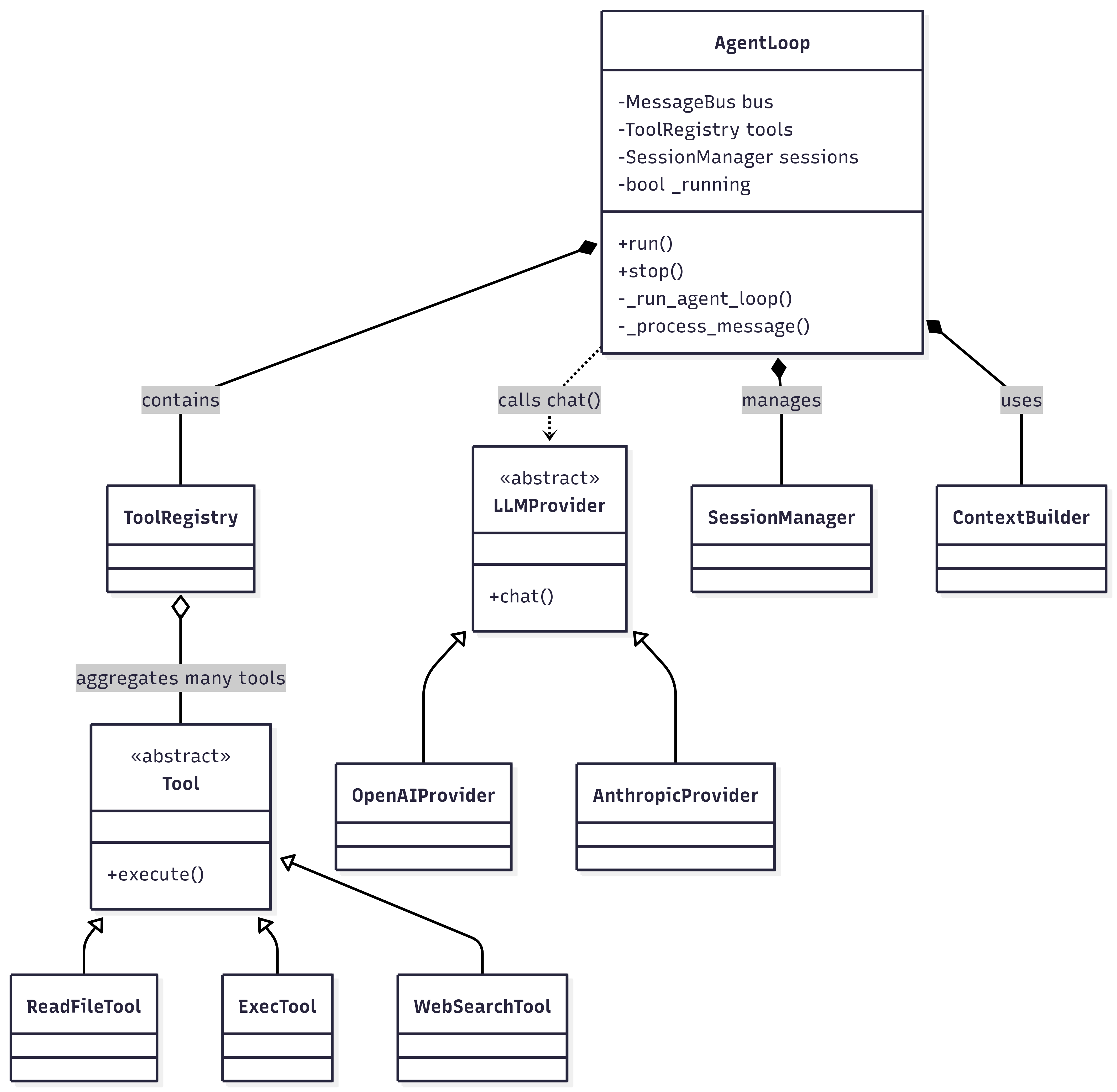
Minimalist System Diagram
The diagram below illustrates the seamless coordination of the four OOP pillars to create a complete orchestration engine:
 Figure 1: The orchestration architecture of AgentLoop.
The Takeaway
The difference between a “fun prototype” and a production-grade AI system doesn’t lie in how cleverly you write your prompts. It lies in how you organize your software architecture.
The lesson I learned after tearing down and rebuilding loop.py: The Language Model (LLM) is the brain, but without a solid architectural skeleton, that brain cannot support a body capable of enduring sustained, real-world operation.